

🌸 Crape Myrtle Trees in Lafayette, LA (Zone 9 Guide)
Why They’re Hurricane‑Tough, Long‑Blooming, and Perfect for Acadiana Landscapes

🌬️ Why Crape Myrtles Are Practically Hurricane‑Proof
Crape myrtles are one of the most storm‑resilient trees you can plant in South Louisiana. Their flexible wood bends instead of snapping, and their multi‑trunk structure allows wind to pass through the canopy. After hurricanes, they’re often the only trees still standing upright in older neighborhoods.
Why they survive storms so well:
- Flexible branches that don’t break easily
- Deep, strong root systems
- Multi‑trunk structure reduces wind resistance
- Fast recovery even if damaged
This is why you see them lining Lafayette streets, parking lots, and older neighborhoods — they’re reliable.
➡️Learn more about flowering trees in our full landscaping services in Lafayette, LA guide.
🎨 The Only Tree in Zone 9 With 100+ Days of Color
No other ornamental tree in Acadiana gives you three straight months of blooms.
Crape myrtles bloom from late May through August, sometimes into September depending on the variety.
Color options include:
- Pure white
- Bubblegum pink
- Hot pink
- Lavender
- Deep purple
- Watermelon red
- Coral
- Burgundy
This is why they’re the backbone of summer landscapes in Lafayette — they stay colorful when everything else is melting in the heat.
🌳 Canopy vs. Upright Varieties (Choosing the Right Shape)
Crape myrtles come in three main growth habits, and choosing the right one prevents future problems.
1. Canopy / Umbrella‑Shaped Varieties
These create a wide, arching top — great for shade and curb appeal.
Examples:
- Natchez (white)
- Muskogee (lavender)
- Tuscarora (coral pink)
2. Upright / Vase‑Shaped Varieties
These grow tall and narrow — perfect for tight spaces.
Examples:
- Dynamite (red)
- Catawba (purple)
3. Dwarf / Shrub‑Form Varieties
Great for flowerbeds, around pools, or along fences.
Examples:
- Pocomoke
- Dazzle series
- Petite series
🆕 New Crape Myrtle Varieties Hitting the Market
Breeders have released new lines with:
- Powdery mildew resistance
- Longer bloom cycles
- More compact shapes
- Richer colors
Popular new introductions include:
- Black Diamond® Series — dark burgundy leaves + bright blooms
- Enduring Summer® Series — reblooming habit
- Early Bird™ Series — blooms earlier than traditional varieties
These modern varieties are perfect for Lafayette’s heat and humidity.
🐜 Common Insects & Diseases in Acadiana
Crape myrtles are tough, but they can get a few issues:
1. Aphids → Black Sooty Mold
Aphids drip honeydew, which causes black soot on the trunk and leaves.
Good news:
You can power wash the black soot off the trunk without harming the tree.
2. Bark Scale
White, crusty insects on the trunk. Treat with systemic insecticide in spring.
3. Powdery Mildew
White powder on leaves — mostly affects older varieties.
4. Japanese Beetles
Occasionally chew blooms in mid‑summer.
How to Treat Bark Scale, Powdery Mildew & Japanese Beetles
Bark Scale (White, Crusty Insects on the Trunk)
Bark scale is one of the most common issues on crape myrtles in South Louisiana, and it’s very treatable when caught early.
How to treat it:
- Apply a systemic insect drench (imidacloprid or dinotefuran) in early spring
- For active infestations, follow with a horticultural oil spray to smother remaining insects
- Gently scrub the trunk with a soft brush if needed
- Avoid heavy pruning — it stresses the tree and slows recovery
Tip: Bark scale often leads to black sooty mold. Once the insects are controlled, you can power wash the trunk to restore the smooth, furniture‑like bark.
Powdery Mildew (White Powder on Leaves)
Older crape myrtle varieties are more prone to powdery mildew, especially in humid Acadiana summers.
How to treat it:
- Spray with a fungicide labeled for powdery mildew (chlorothalonil, myclobutanil, or neem oil)
- Improve airflow by removing crossing branches
- Water at the base — avoid wetting the foliage
- Choose newer mildew‑resistant varieties when planting
Good news: Powdery mildew rarely kills a crape myrtle — it’s mostly cosmetic and easy to manage.
Japanese Beetles (Chewing Blooms & Leaves)
Japanese beetles show up in mid‑summer and can skeletonize leaves or chew blooms.
How to treat them:
- Hand‑pick beetles early in the morning and drop them into soapy water
- Use pyrethrin or carbaryl sprays for heavy infestations
- Avoid beetle traps — they attract more beetles than they catch
- Keep the tree well‑watered during peak beetle season to reduce stress
Tip: Damage looks worse than it is — crape myrtles bounce back quickly.
How to Prevent Bark Scale, Powdery Mildew & Japanese Beetles
Keeping crape myrtles healthy in South Louisiana is mostly about good timing, airflow, and yearly maintenance. Here’s how to stop most problems before they ever start.
1. Preventing Bark Scale
- Apply a systemic insect drench once a year in early spring (March–April)
- Keep mulch pulled back from the trunk to reduce moisture buildup
- Avoid over‑fertilizing — too much nitrogen attracts sap‑feeding insects
- Wash off early signs of honeydew or soot before it builds up
2. Preventing Powdery Mildew
- Choose mildew‑resistant varieties (Black Diamond®, Enduring Summer®, Early Bird™)
- Plant in full sun — shade encourages mildew
- Prune lightly in late winter to improve airflow
- Water at the base, not overhead
3. Preventing Japanese Beetles
- Keep the tree well‑watered during hot months to reduce stress
- Use beneficial nematodes in the lawn to reduce beetle larvae
- Avoid beetle traps — they attract more beetles than they catch
- Encourage birds (especially mockingbirds) — they eat beetles naturally
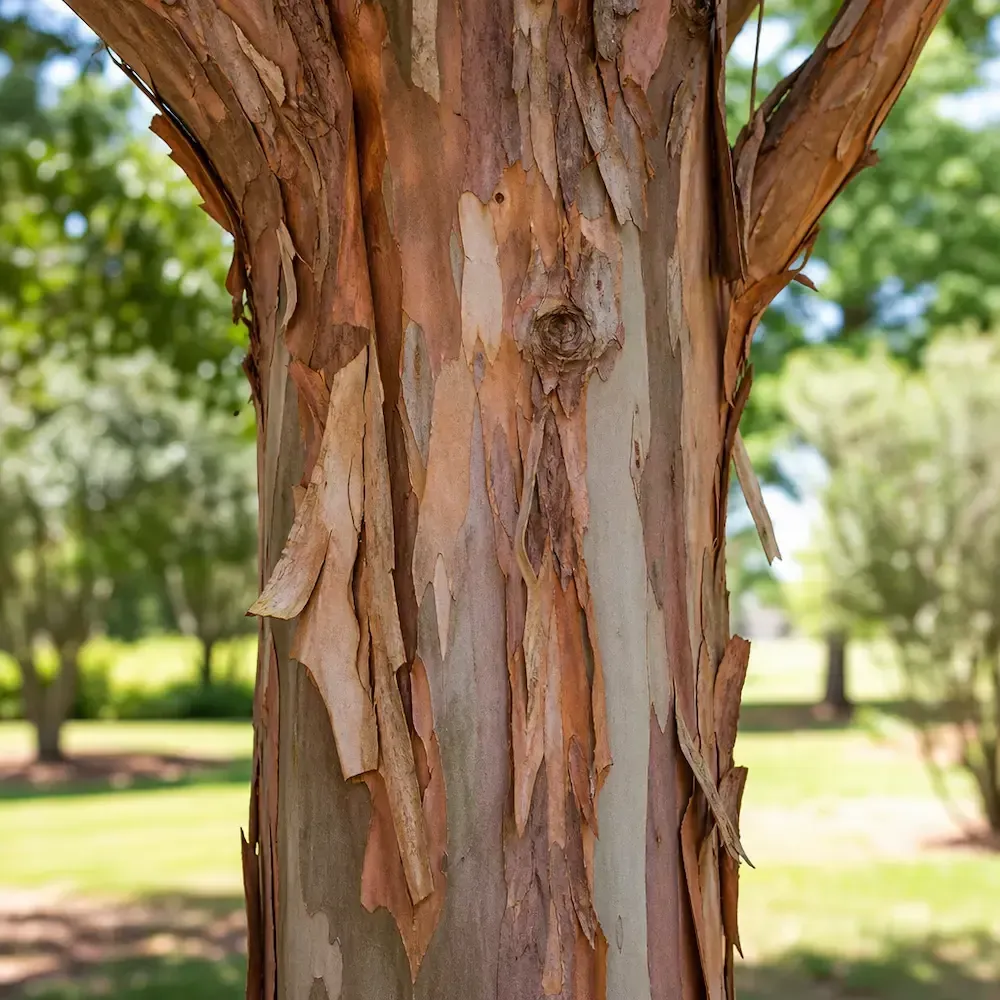
🪵 Why the Trunk Looks Like Furniture Over Time
As crape myrtles mature, the bark exfoliates (peels), revealing:
- Smooth, polished wood
- Swirls of tan, cinnamon, and gray
- A finish that looks like hand‑rubbed furniture
This is one of the reasons homeowners fall in love with them — they get prettier every year.
🧼 Power Washing the Trunk (Yes, You Can)
If your crape myrtle gets black soot from aphids, you can safely:
- Use a gentle pressure washer
- Keep the nozzle at least 12–18 inches away
- Rinse from top to bottom
It restores the natural beauty of the bark instantly.
Signs Your Crape Myrtle Is in Trouble
Even though crape myrtles are some of the toughest trees in Louisiana, they’ll still show early warning signs when something isn’t right. Catching these issues early keeps the tree healthy and blooming all summer.
1. Black Soot on the Trunk or Leaves
This usually means aphids or bark scale are present.
You’ll see:
- Sticky leaves
- Black, soot‑like coating
- Ants climbing the tree
Fix: Treat the insects, then gently power wash the trunk.
2. White Powder on Leaves
This is powdery mildew, especially common in shaded or crowded areas.
Fix: Improve airflow and apply a fungicide.
3. Leaves Turning Yellow or Dropping Early
This can be caused by:
- Overwatering
- Poor drainage
- Root stress
- Nutrient deficiency
Fix: Check soil moisture and apply a balanced fertilizer in spring.
4. Blooms Are Sparse or Small
Common causes:
- Too much shade
- Incorrect pruning
- Lack of nutrients
- Drought stress
Fix: Ensure full sun and fertilize in early spring.
5. White, Crusty Bumps on the Trunk
This is crape myrtle bark scale.
Fix: Apply a systemic insect drench in early spring and follow with horticultural oil.
6. Leaves With Holes or Skeletonized Patterns
This is a sign of Japanese beetles.
Fix: Hand‑pick beetles early in the morning or use a labeled insecticide.
7. New Growth Looks Weak or Twisted
Often caused by:
- Herbicide drift
- Severe drought
- Root damage
Fix: Water deeply and avoid spraying weed killers near the tree.
✂️ How & When to Trim Crape Myrtles in Zone 9
When to Trim
- Late January through early March
- Before new growth starts
- After the last freeze risk
How to Trim (The Right Way)
- Remove crossing branches
- Remove suckers at the base
- Thin out the center for airflow
- NEVER top them (“crape murder”)
- Keep the natural shape
A properly pruned crape myrtle looks elegant — not chopped.
🌱 How to Fertilize & When
When
- Early spring (March–April)
- Optional light feeding in June for extended blooms
What to Use
- Balanced fertilizer like 10‑10‑10
- Or a slow‑release tree/shrub fertilizer
How Much
- Spread evenly under the canopy
- Water in well
🏡 How Far to Plant From a House or Driveway
Crape myrtles have non‑aggressive roots but spacing still matters.
Planting Distance Guide
- Small varieties: 3–5 ft from structures
- Medium varieties: 6–8 ft
- Large canopy varieties: 10–15 ft
This prevents:
- Branches rubbing the house
- Blocking walkways
- Overhang issues
Crape Myrtle FAQ (Louisiana Zone 9)
How often should I water a crape myrtle?
Once established, crape myrtles only need deep watering once a week during hot, dry periods. Newly planted trees need watering 2–3 times per week for the first month.
Do crape myrtles need full sun?
Yes — they need 6+ hours of direct sunlight to bloom properly. Shade = fewer blooms.
When is the best time to prune a crape myrtle in Zone 9?
Late January through early March. Prune before new growth starts and never top the tree.
How tall will my crape myrtle get?
It depends on the variety:
- Dwarf: 3–5 ft
- Medium: 10–15 ft
- Large canopy: 20–30+ ft
Why is my crape myrtle not blooming?
Common reasons:
- Not enough sun
- Over‑pruning
- Too much nitrogen fertilizer
- Drought stress
What causes black soot on the trunk?
Aphids or bark scale. Once treated, you can power wash the trunk to restore the smooth bark.
Are crape myrtles hurricane‑proof?
They’re one of the most wind‑resilient trees in Louisiana thanks to their flexible wood and multi‑trunk structure.
How far should I plant a crape myrtle from my house or driveway?
- Small varieties: 3–5 ft
- Medium: 6–8 ft
- Large canopy: 10–15 ft
Crape myrtles are more than just beautiful trees — they’re a symbol of strength, color, and Southern charm that thrive right here in Acadiana. Whether you’re planting one for shade, curb appeal, or year‑round beauty, these hurricane‑tough trees reward you with decades of color and character. From their long summer blooms to their furniture‑smooth bark, crape myrtles prove that the best Louisiana landscapes are built to last.
If you’re ready to add one to your yard, stop by Beau Monde Nursery Landscape & Florist in Scott — we’ll help you choose the perfect variety for your space.
Contact Us